

Scars are our bodies natural “glue”. They form in wounds to try to weld together the damaged tissue, thus allowing us to function again. Collagen type 1 (the building material for every scar) is the chameleon of the cellular world. It is able to mimic the surrounding cells and tries to form a scar that is as similar in its properties as that of the parent tissue.
In the ideal world, these scars form perfectly and require no attention, however this is not always the case. Our jobs as Physiotherapists are to provide the optimal environment for the formation of scars, and the necessary treatment so that they allow for full, functional movements.
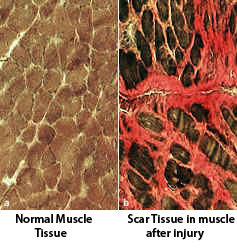
Lets take the example of a hamstring tear: When we tear a muscle, we damage muscle cells (fibers). These damaged cells do not regenerate themselves (you don’t form new muscle cells), you merely glue the tear up with collagen.
At first this collagen is delicate and fragile, but as it matures, it becomes thicker and stronger. It needs to become as strong as the rest of the hamstrings, so it can take load through it, but at the same time, it needs to be able to stretch so that it doesn’t tear again.
Start training too early and you tear the newly forming collagen, so the body lays down more collagen to try fix it and you end up with a thick scar that limits movement. On the flip side, if you delay putting load through the scar for too long (stretching or exercise), the scar will be “disorganized” and weak, and could re-tear.
The second problem with scars is that they can also “glue” together 2 different types of tissue. So getting back to the hamstring tear, when you tear the muscle, you most likely also damage the surrounding fascia. This thick “mesh” like tissue covers individual muscles and groups of muscles too. If the new scar welds together the muscle and the surrounding fascia, it will restrict the entire movement of that area, and can often affect the joint (e.g.knee).
This applies even more so when the skin has also been damaged (as in the case of a knife wound or surgery), as there are now multiple-layers of tissue that can become welded together. Occasionally we also see that nerves become “trapped” in scars and this further complicates matters.
So, in summary, the timing of therapy to the scar and the ability of you therapist to distinguish which structures are affected will greatly improve your outcome after injury. If only someone had told poor Harry Potter…
Happy Healing
Ric@PhysioPRO
BY: Riccardo Vaccaro
General Health/Fitness