

Although this may seem trivial to some, the number of patients that are unaware of whether to apply hot or cold therapy to an area has prompted me to write this article.
Let’s start with a common scenario… A player feels a sudden sharp pain in the hamstrings whilst playing soccer. He finds it difficult to continue playing. Should he use ice or a hot water bottle?
The second scenario…. A few days after a heavy workout, a player feels strong discomfort in the hamstrings when walking or climbing stairs. What should he do??
Both these scenarios involve a muscular issue involving the hamstrings, however they should be handled very differently. To understand why, we need to understand the effects of heat and ice…
Heat:
- Increases blood flow to the area through dilating blood vessels, thus transporting proteins, nutrients, and oxygen for better healing
- Increases cell metabolism
- Increases the tissues ability to stretch (extensibility)
- Relieves muscular spasm
Cold:
- Reduces blood flow through constricting vessels, thus reducing internal bleeding
- Decreases cell metabolism which will slow down an inflammatory reaction
- Reduces pain (analgesia)

So, in cases of ACUTE INJURIES (where we are trying to reduce the inflammatory response), one should apply ICE to the area as soon as possible and continue for the first 72 hours. It is recommended to only apply ice for 10 minutes and then wait 50minutes before applying again (i.e. 10 minutes every hour). This is to prevent a reaction (known as the “Hunting response”) which will actually INCREASE blood flow to an area that gets too cold for too long.
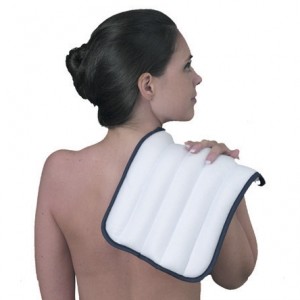
On the other hand, HEAT is used to treat CHRONIC INJURIES where there is no swelling or bruising. Usually this is for sore, nagging muscular aches or stiff joints. It’s great for muscular tension and can be applied for 15-20 minutes at a time, taking care not to burn the skin. This can be in the form of a hot water bottle/heat packs or just a really hot bath.
So from the above it should be obvious that scenario number 1 needs to ICE his injury as he probably has a hamstrings muscle tear. He should also follow the PRICER principles – see this article
The athlete in scenario 2 should use HEAT and stretching to relieve his muscular pain as his is not an acute injury and most likely post training muscle stiffness (delayed onset muscle soreness – DOMS).
Hope that this helps you clear up when to apply which therapy.
Ric@PhysioPRO
BY: Riccardo Vaccaro
General Health/Fitness