
As a physio, I often hear these questions:
• “What type of exercise should I be doing to build muscle?
• “I’m going to gym and training hard…but I don’t see the results on the sports field. What am I doing wrong?”
Here’s some food for thought:
In order to obtain maximum muscle growth and see rapid progress it is important to bring  variety into your training and put your body through different kinds of resistance exercises. Body- weight training – working against your own weight – is a great way to train as it does not require any equipment and all of the muscles of the body can be worked. Unfortunately when a lot of people start out, many of them are unable to do pull-ups or push-ups lifting their entire body weight. So it is easier to start
 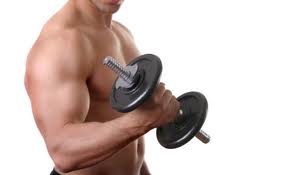 with additional resistance training i.e. using dumbbells or handheld weights. Dumbbells are an extension of body-weight training, but are less restrictive as you can vary the resistance slowly as you get stronger. Stronger athletes can go beyond using only their body weight by increasing the weight of the dumbbells.
Elastic Resistance – using the resistance of an elastic band – is also a great way to train as the elastic band provides significant resistance but does not weigh anything (plus they are easy to transport and store at home).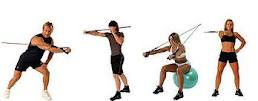
Elastic resistance is very different to the resistance provided by body-weight or dumbbells. The more you pull on an elastic band the greater the resistance, so there will be more resistance at the end (inner range) of the movement.It is very important to maintain control throughout the entire movement – while pulling in and while letting go – and not just let the elastic recoil rapidly back to the starting position at the end of the repetition.
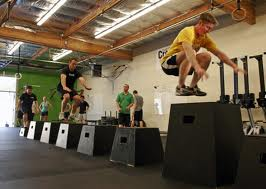 An important type of resistance – especially for athletes – and one that people don’t focus on much is Plyometric Resistance. Plyometrics bring together the strength gained in the gym and the increase in performance gained by high intensity exercise. It is particularly important for athletes who need muscle reactivity, and can help you transform your strength into explosiveness which is essential on the sports field! Plyometric resistance comes into play when you force your muscles to abruptly stop a movement and then go in the opposite direction e.g. jumping off a box, landing while absorbing the shock, and using it to jump as high and as fast as possible. Very, very important in any plyometric exercise is to limit contact with the floor, movements needs to be fast and explosive!
Too much of a good thing can very easily become a bad thing….same goes for plyometrics. So as soon as you notice that the time of contact with the floor becomes too long and you are slowing down too much, know that you are fatiguing and the set should be interrupted for a slight rest time.
In conclusion, it would not be wise to choose one type of resistance over another but rather to combine all of them into your training routine. The net effect will be putting your body through cumulative resistance training that is superior to a focus only on any one particular method of training.
Happy training 🙂
Andrew@PhysioPRO
BY:
General Health/Fitness